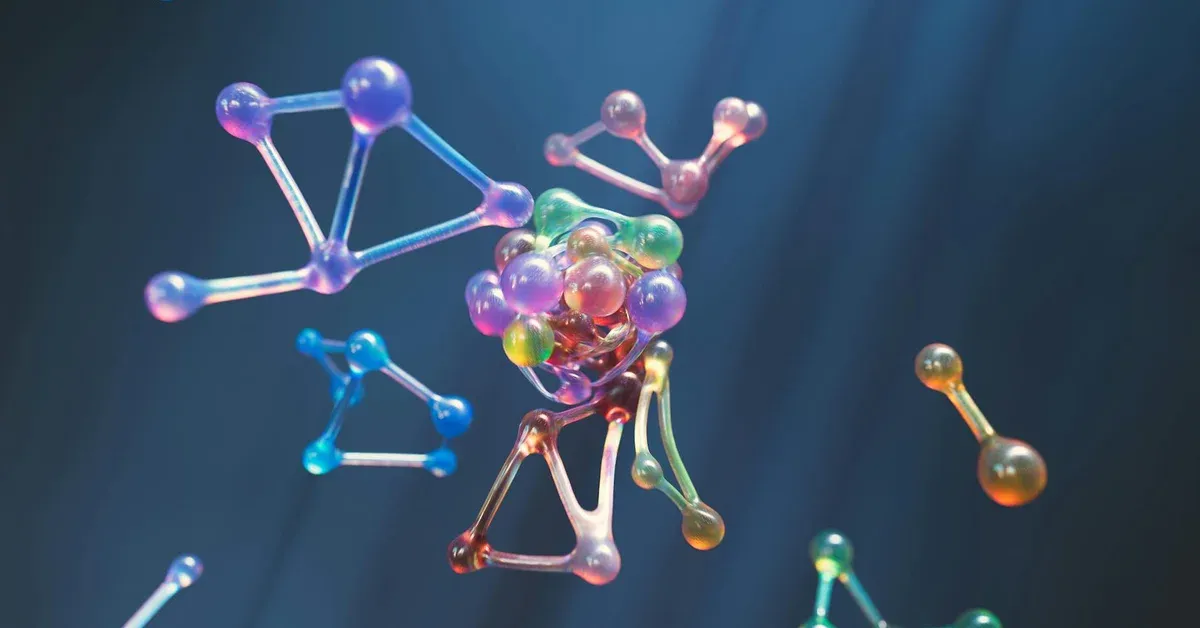
The rule has always been simple: polar substances like water dissolve other polar substances, while non-polar ones like oil stick with non-polar substances. They don’t mix. But researchers from NASA and Chalmers University of Technology looked at Titan’s freezing alien chemistry and found something shocking. Under extreme conditions, molecules that shouldn’t get along are actually forming new solid compounds together.
Where Chemistry Rules Don’t Apply
Picture a world where the air is thick with nitrogen and methane, and lakes are filled with liquid hydrocarbons instead of water. That’s Titan. It’s so strange it seems like science fiction. Temperatures drop to 90 Kelvin, which is about -298°F. This creates an environment completely different from Earth.
Titan’s thick atmosphere contains lots of hydrogen cyanide (HCN). On Earth, HCN is a polar molecule that wants to dissolve other polar substances. But methane and ethane, which are everywhere on Titan, are non-polar. Based on everything we know, these molecules should avoid each other completely.
But when scientists recreated Titan’s conditions in their lab, these “incompatible” polar and non-polar substances mixed together easily. This means Titan’s surface might be full of unusual chemical reactions, creating “impossible molecular combinations” that shouldn’t exist according to our textbooks. The extreme cold seems to force these molecules into new interactions that break our basic understanding of how substances work together.
How These Impossible Crystals Actually Form
So how does this chemical rule-breaking actually happen? The answer is what researchers call “host-guest” relationships. Instead of dissolving into each other as liquids, the molecules form new types of solid crystals. Think of it like a molecular cage where polar hydrogen cyanide molecules create a framework that traps non-polar methane and ethane inside.
These molecular cages, called clathrates, only stay stable under Titan’s unique cryogenic molecular formation conditions. The extreme cold locks these different molecules into a rigid structure, stopping them from pushing each other away like they would at warmer temperatures. This means Titan’s icy crust, which can be miles thick, could be packed with these alien compounds.
This completely changes our “understanding how molecules behave” and interact with each other. It reminds us that the universe works on principles much more diverse than what our Earth-based labs might suggest. Our basic knowledge of natural chemistry just got a major update.
What This Means for How Life Started
This discovery goes beyond being just a space curiosity. This planetary chemistry anomaly has huge implications for one of humanity’s biggest questions: how did life begin? Scientists think that conditions on early Earth, before life existed, might have been similar to modern Titan, especially regarding similar precursor molecules and changing temperatures.
If hydrogen cyanide, methane, and other simple “molecules” could form complex “extraterrestrial compounds” under such harsh conditions, it opens up new possibilities for how “life’s building blocks form.” What if early Earth’s chemistry didn’t follow the “like dissolves like” rule strictly? What if these “impossible crystals” were actually a crucial step, providing a stable environment for complex organic reactions that eventually led to life?
This creates an exciting new path for exploring abiogenesis, the process where life comes from non-living matter. It suggests that even in environments we thought were too harsh, complex “molecular formation” could be happening, leading to unexpected biological results. It also makes us wonder what other “alien compounds science” might find on other cold bodies in our solar system and beyond, forcing us to rethink fundamental processes, similar to how science is challenging hygiene norms.
Titan isn’t just a distant moon. It’s a cosmic laboratory forcing us to expand our chemical understanding. This “Titan chemistry breakthrough” reminds us that the universe constantly surprises us, pushing the boundaries of what we know and showing us a much weirder, more wonderful reality than we ever imagined.